
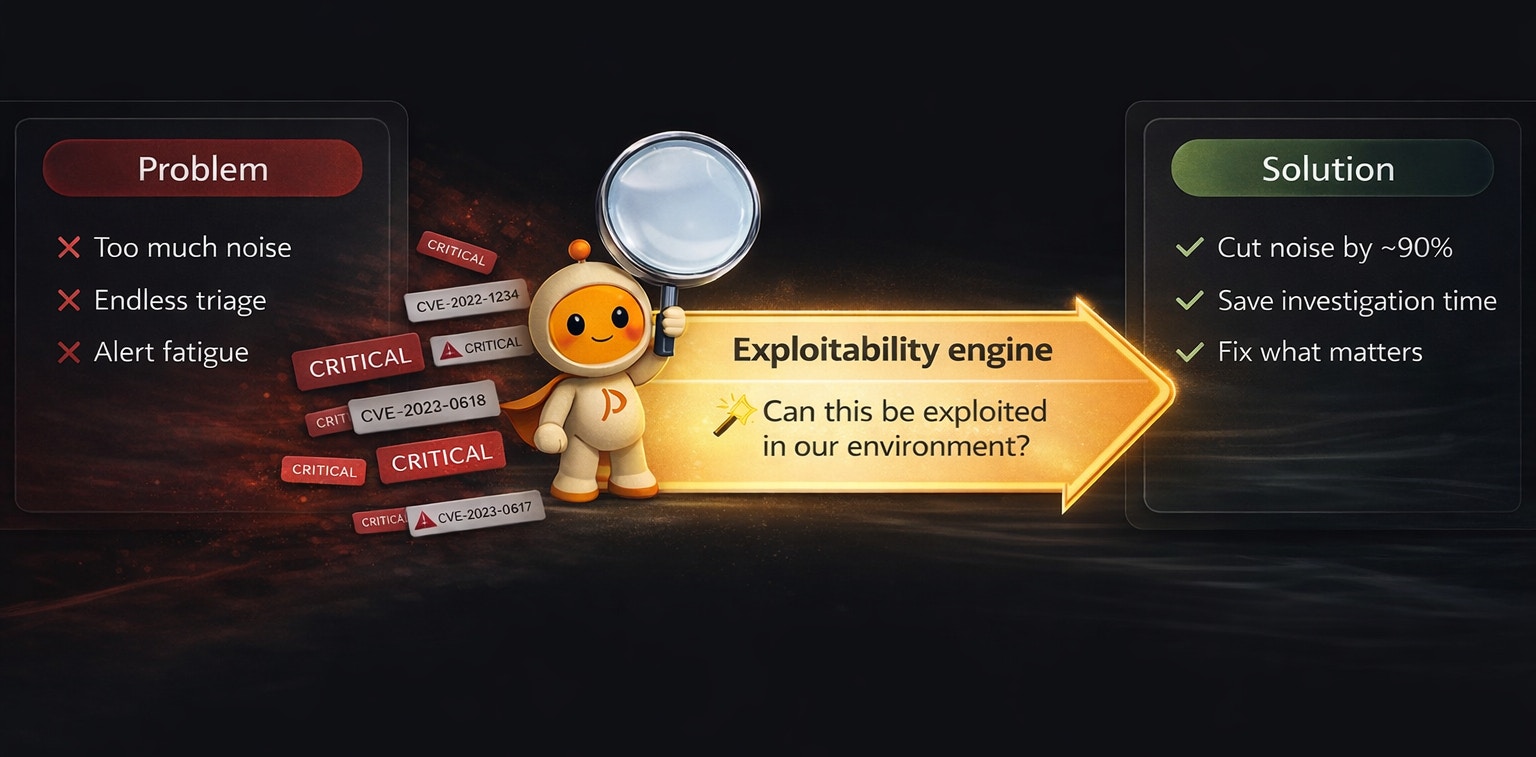
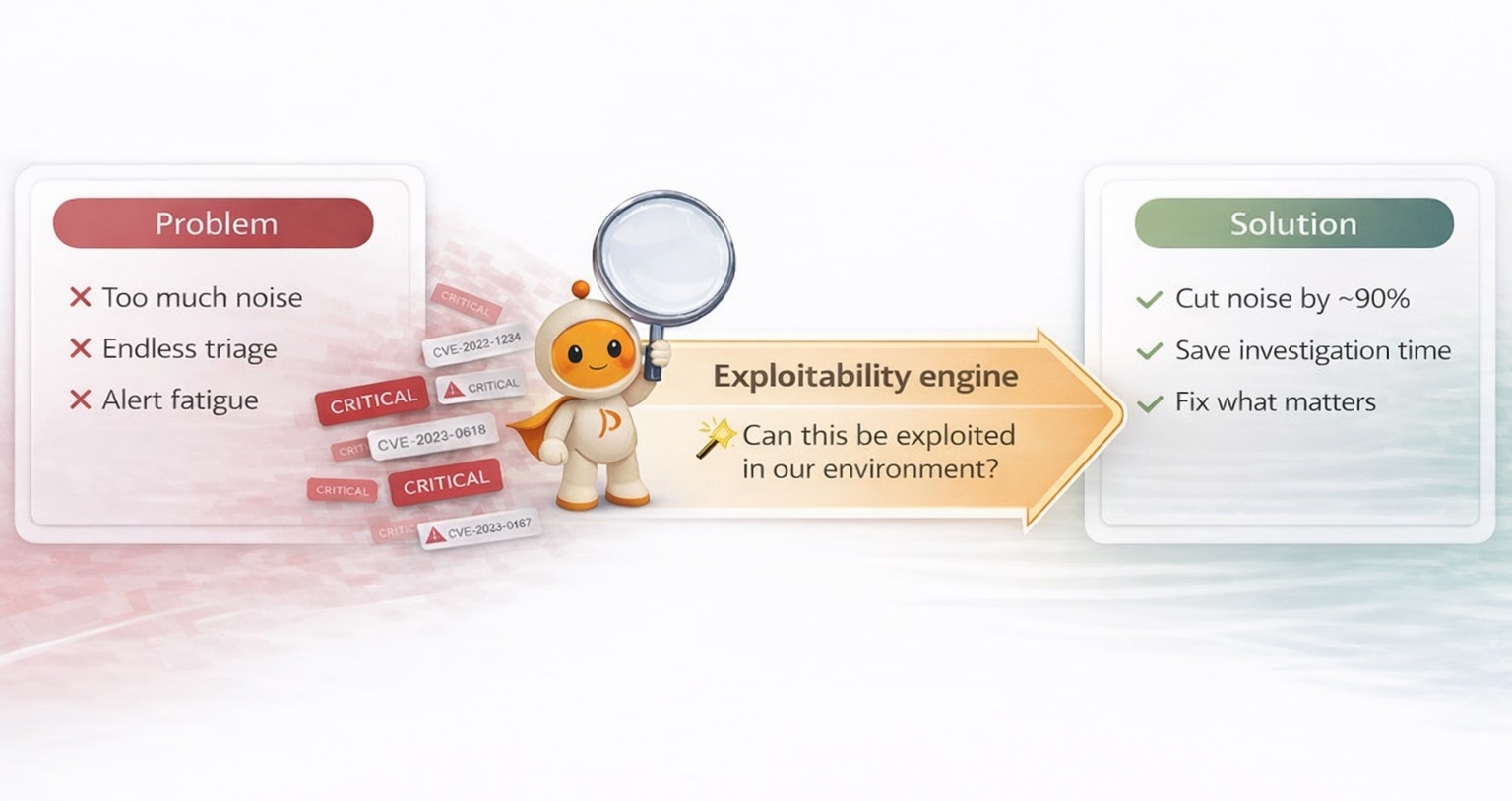
- thousands of findings across cloud and code
- critical findings that don’t match real-world risk
- endless spreadsheets, meetings, and manual triage
- engineering time spent patching low-impact issues, instead of improving product
- a constant worry that the one truly exploitable issue is buried
The question: is it exploitable here?
A CVE is not automatically exploitable everywhere. Vulnerable code, written on a piece of paper, sitting on your desk, cannot be executed by an attacker to gain access to your computer. It has to be present on your system, part of a running service, exposed to the network, with a path to the internet. Every vulnerability has requirements like these. Think of them as a checklist of preconditions that an attacker needs to meet to succeed. Examples of exploitation requirements:- the operating system must be a specific type (Windows vs Linux)
- the system architecture must be a specific type (x86_64 vs ARM/Graviton)
- a specific feature must be turned on
- a service must be running and reachable over the network
- a specific version of a software library must be present and used
- certain hardware must be attached
Examples: Critical on paper, not exploitable in practice
Here are common cases that create noise and drive alert fatigue. A CVE can be rated critical in a generic database, but the exploit requirements don’t fit how we actually run the workload.Example 1: Windows-only vulnerability on a Linux workload (CVE-2024-49138)
- What we see: CVE-2024-49138, a critical Windows privilege escalation vulnerability, flagged on this server.
- Exploit requirements: the target must be running Windows.
- Our reality: the asset is running Linux.
- Result: not exploitable on this asset. It shouldn’t compete for attention and engineering time.
Example 2: RDMA requirement (CVE-2023-25775)
- What we see: CVE-2023-25775, a high severity vulnerability in the Intel Ethernet Controller RDMA driver.
- Exploit requirements: RDMA-capable hardware with the Intel RDMA driver installed.
- Our reality: standard NICs, no RDMA.
- Result: not exploitable on this asset.
Example 3: Network reachability (CVE-2024-6387)
- What we see: CVE-2024-6387 (regreSSHion), a critical remote code execution vulnerability in OpenSSH.
- Exploit requirements: OpenSSH server (sshd) must be running and reachable by an attacker.
- Our reality: sshd isn’t running on this asset.
- Result: not exploitable on this asset.
Operational severity: what’s urgent for us?
Once we know a vulnerability can be exploited, the next question is priority: How urgently do we need to act in our environment? There’s a difference between:- Base severity: a generic score (like CVSS) that tries to describe an abstract worst-case impact.
- Operational severity: the score for our asset and environment, based on exploitability plus context.
- Not exploitable: deprioritize with confidence.
- Likely not exploitable: deprioritize, but not completely, as evidence isn’t 100% conclusive.
- Likely exploitable: fix first, track to closure, align to SLAs.
- Unclear / missing evidence: investigate manually, then decide.
Explainable decisions
I don’t just give you a severity score and send you on your way. I give you the reasoning you need to trust it. For each vulnerability on each asset, I show the requirements, whether each requirement is met, and what evidence and reasoning supports it. That means you can answer the questions that always come up:- Why did we deprioritize this?
- What would make this exploitable?
- What do we need to change to reduce exposure?
Orchestration: drive remediation to done
Once we know what matters, I help the team fix it without the usual coordination tax:- create Jira issues or raise pull requests, aligned to SLAs
- provide clear remediation guidance engineers can act on
- show impact (e.g. fixing this resolves 158 vulnerabilities across 12 VMs)
- verify fixes and close the loop
- keep updates in Slack, Microsoft Teams, or email
The benefits I bring
Cut noise by ~90%
Reduce alert fatigue by filtering out vulnerabilities that aren’t actually exploitable on our assets, so the backlog shrinks to what matters.
Save investigation time, fix real risk faster
I explain what’s exploitable and why (with an audit trail for engineers and auditors), then drive remediation to closure for the vulnerabilities that truly need fixing.